
Learning

Projects Resources

2026 Programme Announcement

Since its conception in 2000, Transport for London’s Art on the Underground programme has been at the forefront of critically engaged programming that reflects on the changing nature of public space, challenging the idea that public art is fixed.

Through commissioning artists in an open examination of community, space and place, the programme has a renowned history of commissioning site specific work that brings unexpected interactions and new perspectives to millions of people travelling through London. 2026 continues that tradition with a series of commissions that explore subterranean histories, lost voices and hidden labour.

Art on the Underground’s programme for 2026 comprises major new works by five contemporary artists which will be displayed at Tube stations across London, including:

  • ​​​​​​a new series of works by interdisciplinary artist Phoebe Boswell at Notting Hill and Bethnal Green stations launching March 2026


  • a new artwork by Ellen Gallagher for the Summer 2026 Pocket Tube Map cover


  • a new audio commission by artist, composer and DJ Ain Bailey for Waterloo station in June 2026


  • a large-scale commission by Scottish painter Caroline Walker at Stratford station launching September 2026


  • and a new artwork by Hurvin Anderson marking the 10th commission of the Brixton Mural Programme in November 2026


In its breadth and presence across London, the 2026 programme reflects historic imbalances and under-representation, reframing public space and bringing artworks to the city which are relevant to life today.

The Congregation

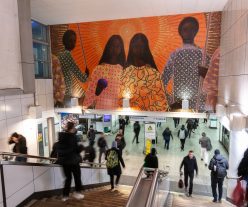
The Congregation is a new mural artwork for Brixton Underground station by artist Rudy Loewe. Launched on 20 November 2025, the work will be on view for a year.

Loewe is a multidisciplinary artist working across painting, drawing, and sculpture. Their work invites and amplifies those voices suppressed by dominant retellings of history, thereby making space for different forms of knowledge. It channels the narrative energy of comics and the clarity of illustration by combining text and image with the use of vivid colour.

The Congregation honours Brixton’s history as a place of resistance and community gathering, particularly for London’s Black communities. The work features twenty scenes celebrating the figures and history of the local area. Loewe interweaves stories from archival research and interviews, visualising the rich, sensorial experience of Brixton. With The Congregation, Loewe offers an alternative entry point into Brixton as a place that has been a focal point for Black communities over the last 75 years.

Loewe’s new work for Brixton pays tribute to figures and communities which have shaped the culture of the local area, including depictions of the Windrush Generation’s arrival in Brixton in the late 1940s and SisterMatic, a Black lesbian-run sound system who have been known for offering much-needed lesbian nightlife in the area, and beyond, since the mid-1980s. Other sitters include, TfL Train Operator, CJ Rivers, depicted with their child, and activist Marcia Rigg in ‘Holding the Flame’, a virtual statue created by Aswarm in memory of her brother, Sean Rigg, who died in police custody at Brixton Police Station in 2008.

The work also features local landmarks, places and cultural spaces, such as the 121 Centre on Railton Road, one of the UK’s longest-running squats, where famously activist Olive Morris lived during the 1970s; Southwyck House, a large brutalist-style housing association development known locally as ‘Barrier Block’ for its dominating presence; and artist Pearl Alcock’s underground bar, which she ran from her flat on Railton Road as a social space for Black gay men in the 1990s.

Brixton’s activist history is honoured through the inclusion of sites such as the Frontline Off Licence on Atlantic Road, a significant landmark as the site of the first resistance during the 1981 Brixton Uprising; and the annual noise demonstration outside HM Prison Brixton, taking place every New Year’s Eve in solidarity with prisoners.

Alongside Brixton’s history of activism and community organising, Loewe highlights daily acts of intergenerational gathering, joy and care. People are depicted chatting outside The Powerful Hand, a spiritual shop, as long queues form outside Healthy Eaters, a popular Jamaican restaurant. Teenage girls walk through the streets as women shop with young children at the market on Electric Avenue, and older men meet and chat in Windrush Square.

The Congregation visualises the rich social and political history of the local area and the intertwined stories of its people and communities, which have made and continue to make Brixton a place of gathering, connection and collective resistance, particularly for Black communities.

Go Find Miracles

Go Find Miracles was a new sound artwork by 2023 Turner Prize-nominated artist Rory Pilgrim for Waterloo station commissioned by Art on the Underground.

This new work emerged from Pilgrim’s long-term work with those affected by the criminal justice system. Recorded in two underground locations, with Go Find Miracles, Pilgrim asked how we go beneath the surface to imagine new structures of repair and possibility.

The work was developed in collaboration with HMP/YOI Portland and the Prison Choir Project, as well as the Mayor of London’s Culture and Community Spaces at Risk programme (CCSaR) and the Feminist Library in Peckham. Go Find Miracles could be heard at Waterloo Underground station along the travelator connecting the Northern and Jubilee lines, between 14-25 July 2025.

Rory Pilgrim works collaboratively and in dialogue with others, across music composition, performance, film, drawing and text, reflecting and redefining how we come together to shape social change.

Go Find Miracles focused on the role that the Isle of Portland, a small island in the English Channel, has played in shaping London through its quarries. Portland stone has been used to build many of London’s most iconic buildings, including the Tower of London, St Paul’s Cathedral, TfL’s historic headquarters – 55 Broadway, and Waterloo station itself. Trains to and from Portland’s closest station, Weymouth, arrive and depart from Waterloo – which acts as a gateway to the island, whose resources have built so much of the capital.

The Isle of Portland is also the site of two prisons, including HMP/YOI Portland, and the former site of prison barge HMP Weare and the Bibby Stockholm which temporarily housed asylum seekers. The labour of the people imprisoned on the island has historically shaped its landscape, with the many stone quarries originally being worked by imprisoned people who were initially brought to Portland in 1848 to construct the 2.84-mile-long harbour breakwater.

Expanding from Pilgrim’s long-term collaboration with communities on Portland and developed following a workshop at The Feminist Library in London, which used collections of intersectional feminist literature from the 1970s until the present day, Go Find Miracles explored the ways that the law impacts our lives and our environment. Reflecting on the idea of a miracle as an opening for change and a prayer as a sequence of connection through the words we share with each other, the artwork was structured around a call and response prayer.

Go Find Miracles was recorded underground in a Portland stone quarry, amongst the layers in which deep time connects us with our modern world, and on the disused Jubilee line platform at Charing Cross London Underground station: bringing voices from Portland and London together.

The sound work took the form of a conversation, spoken reflections and poetry by Carina Murray and Holly Upton were accompanied by music composed by Pilgrim and sung by soloist Robyn Haddon, alumni of the Prison Choir Project, and a further choir of singers with whom Pilgrim has previously collaborated for projects including pink & green, 2024 and RAFTS, 2022. The lyrics and melodies of the work were partly written together with men from HMP/YOI Portland.

Constituting a prayer of call and response that ultimately traces a 10-minute loop without end, Go Find Miracles asked, if we break the loop, is it here we find space for miracles?

Go Find Miracles could be heard alongside visual artworks by Pilgrim depicting songbirds carrying messages between London and Portland. These drawings were installed throughout Waterloo Underground station making visible the listening experience and the ripple of connection between the two places explored in the work.

An expanded leaflet documenting the development of Go Find Miracles was available to collect from the station. A short film by 2025 Jarman award nominees, Other Cinemas, about the making of Go Find Miracles, is available to view here.

Go Find Miracles is the third audio commission developed in collaboration with The Mayor of London’s Culture and Community Space’s at Risk programme (CCSaR) to spotlight and amplify grassroots organisations they have supported, and produce audio installations that can be heard across London Underground stations.

Credits

Collaborators: The Mayor of London’s Culture and Community Spaces at Risk team, The Feminist Library, HMP/YOI Portland, Learners from HMP/YOI Portland & The Prison Choir Project

Design: Wolfe Hall

Production & facilitation: Elizabeth Graham & Rory Pilgrim

Composition: Rory Pilgrim

Speakers: Carina Murray & Holly Upton

Sound recording & mixing: Lucas August

Sound editing: Nada Smiljanic

Singers: Adam Green, Darren, George Chron, Marcello, Robyn Haddon, Todd Harris, Seraphina D’Arby and Marged Siôn

TfL Colleagues: Fernando Soler & Lota Anyakora

Recorded in an Albion Stone Ltd Portland stone mine on the Isle of Dorset, The Crypt Studio and on the disused Jubilee line platform at Charing Cross Underground station.

Map Projections

An artwork by Agnes Denes, a leading pioneer of the environmental art movement, features on the cover of the 41st Pocket Tube map, which launched on 12 June 2025 on posters across the city. Commissioned by Art on the Underground in the organisation’s 25th anniversary year, the 41st Tube Map Cover continues Denes’s exploration of environmental and social issues and the challenges of global survival.

Denes’s Map Projections is a digital drawing that presents an alternate perception of space and time by projecting a section of the globe onto a cube rather than a sphere. It renders a 3D form into a 2D artwork by a process called isometric projection, often used in technical sketches, and references Denes’s renowned 1970s series, Isometric Systems in Isotropic Space – Map Projections, which took the familiar form of the globe and distorted it into different shapes, including The Hotdog, The Pyramid and The Snail. The outline of the continents in the current and previous works precisely follow this distortion.

The new form of the globe is an “electrified” rendering, with glowing lines illuminated against a pitch-black background. This transformation of the globe into a distorted, electrified form is similar to the way that the Tube map turns the London transport network into a navigable diagram.

Throughout her career, Denes’s scientifically-based drawings, prints and architectural designs have combined science, mathematics, philosophy and environmentalism. Her pioneering environmental art, including Wheatfield – A Confrontation (1982), a two-acre field of wheat planted and harvested in downtown Manhattan, New York, is one of many monumental works that have drawn attention to global ecological disaster and demonstrate Denes’s role in transforming the Land Art movement towards social action.

Map Projections will be printed on the cover of pocket Tube maps from early July. The maps will be available for free at all TfL stations, and a poster with the design is now displayed across the network, offering a preview.


Art on the Underground Staff Writer in Residence 2023 at St James's Park

‘Ode to the Mother’ is the second release from the Art on the Underground Writer in Residence Anthony Okolie. Inspired by ‘Rebirth of a Nation’ an artwork currently on display at Brixton Underground station until winter 2024 by artist Jem Perucchini.

‘Ode to the Mother’ will be installed on the platform of St James’s Park Underground Station as an artwork poster, launching February 22nd 2024 and on view for one year.

Anthony explained that the ‘the tale of the Ivory Bangle Lady conjured the notion of the strong women and mothers often taken for granted and seldom acknowledged as much as they could be.’

Anthony is a London-based creative writer and filmmaker and has worked at TfL for 6 years. Anthony’s artistic style takes inspiration from many sources, including history, psychology and the wonder he finds in the so-called ‘mundane’ aspects of everyday life. Anthony takes pride in portraying as much authenticity and realism in his art, highlighting the different perspectives of people going through similar if not the same routines and emotions.

The Art on the Underground Writer in Residence is a creative opportunity for a TfL staff member to develop their writing by working with TfL’s contemporary art programme Art on the Underground over a period of six months.

The Writer in Residence programme aims to highlight and amplify the creative voices within TfL, creating engaging responses to Art on the Underground’s ongoing programme.


ODE TO THE MOTHER

Saviour Her Equality/Her Equality Ruler,

All hail the almighty creator,

The homemaker,

Hence why, ‘Mother Nature’,

The law of attraction creates infinite life,

Divine feminine, named as the wife,

Unlimited wisdom as a matter of fact,

She can stroke my ego all the way back,

Her sweet voice sings away the blues,

Size 5 but that isn’t why you couldn’t walk in her shoes,

On long wintry mornings, her will never fails,

Through the darkest summers, she somehow prevails,

The cool breeze tempts the leaves,

Tall black trees, rooted in glory,

Bloody cycles of pain she endures to alibi his story,

A happy bereavement deep within.

She raises men,

Soft and cuddly, foremost point of reference,

Incomparable, she can’t be venerated by a single sentence,

Not to mention, walking in the snow,

Looking at the stars to know, we’re connected via soul,

For unforgettable memories, I’m Nat King Cole,

You give me the sense to have it all.


Anthony Okolie – Art on the Underground Staff Writer in Residence

Saved by the Whale's Tail, Saved by Art

19 September 2025 – December 2026

A new artwork co-commissioned by Art on the Underground and New Contemporaries

Ahmet Öğüt is a sociocultural initiator, artist and lecturer, working across a variety of media, including photography, video, and installation. Ahmet often uses humour and interventions to offer commentary on serious or pressing social and political issues. His new commission, ‘Saved by the Whale’s Tail, Saved by Art’, is a major new project that reflects on the vital role art plays in our everyday lives.

At the heart of the commission is a major new installation at Stratford Underground station. The work takes inspiration from a remarkable real-life event that occurred in 2020 near Rotterdam, when a derailed train was miraculously caught by a sculpture of a whale’s tail, preventing disaster. For Öğüt, this surreal and poetic moment became a powerful metaphor for how art—often dismissed as decorative or superfluous—can, quite literally and figuratively, be lifesaving.

To accompany the commission, Art on the Underground and New Contemporaries issued a public call-out for real-life stories from across the UK about times when art has saved, transformed, or reshaped lives. From April to June 2025, posters featuring the call-out were displayed throughout the London Underground network, inviting commuters to reflect on and share their personal experiences.

From hundreds of submissions, Helen Whitley’s story ‘The Bracelet’ was selected and is featured—alongside a range of other powerful entries—in a special publication available for free at Stratford station and on the Art on the Underground website. These stories bring to light the deep personal impact of art across communities, and collectively affirm its essential place in society at a moment when cultural institutions and artistic programmes face growing precarity.

By amplifying these voices, Öğüt’s ‘Saved by the Whale’s Tail, Saved by Art’ not only transforms public space but also invites us all to reconsider what we value, protect, and fight for in our shared cultural life.

2025 Programme Announcement

Art on the Underground’s programme for 2025 comprises major new works from four contemporary artists. Since its conception in 2000, Art on the Underground has been at the forefront of critically engaged programming that reflects on the changing nature of public space, challenging the idea that public art is fixed.  

Through placing trust in artists and the creative process, the programme has a renowned history of commissioning site specific work that speaks to people, places, and histories. 2025 continues that tradition with a series of commissions that allow for meaningful and expansive conversations between artists and the public. 2025 will see a large-scale collaborative artwork by Ahmet Öğüt at Stratford station in collaboration with New Contemporaries, a new audio commission by Rory Pilgrim for millions of commuters at Waterloo station, and a new painting by Rudy Loewe at Brixton Underground station, continuing its series of commissions that respond to the rich history of murals in the area from the 1980s, and the wider social and political history of mural making. 

In its breadth and presence across London, the 2025 programme reflects on the history and movement of the city today. 

Art on the Underground’s 2025 programme features major commissions situated across London including: 

  • a large scale artwork by Ahmet Öğüt at Stratford Underground Station in March 2025 in collaboration with New Contemporaries
  • a new artwork by Agnes Denes for the Spring 2025 Pocket Tube Map  
  • a new audio work by Rory Pilgrim for Waterloo Station in June 2025 
  • and a work by Rudy Loewe for the ninth Brixton Mural Programme in November 2025


Art on the Underground Staff Writer in Residence 2024

The Shark is the first release from the 2024 Art on the Underground Writer in Residence, Kristel Tracey. The work is a reflection and response to A Taste of Home, an artwork by artist Joy Gregory, which is currently on display at Heathrow Terminal 4 Underground station. Like Joy’s artwork, Kristel’s short story is inspired by the stories of the refugee and asylum-seeking communities living in temporary accommodation near the airport and the poems ‘Home’ and ‘Seeds in Flight’ by Warsan Shire and Khaled Abdallah respectively.

Kristel is TfL’s Head of Advocacy and Engagement and has worked for the organisation for just over three years. Previously an avid writer with work published in both print and digital, she is now reexploring her passion for creative writing alongside her career and parenting her 5-year-old daughter.

Kristel said: The stories of the refugee and asylum seeker community Joy spoke to while exceptional and not universal, speak to the deeper feelings of belonging, loss, upheaval, loneliness, anxiety and the desire for home that are universal. We all want to be able to decide for ourselves where home is. It implores the reader to home in on their humanity, rather than headlines that narrow human stories down to dehumanised statistics.

The Art on the Underground Writer in Residence is annual creative opportunity for a TfL staff member to develop their writing by working with TfL’s contemporary art programme Art on the Underground over a period of six months.

The Writer in Residence programme aims to highlight and amplify the creative voices within TfL, creating engaging responses to Art on the Underground’s ongoing programme.

Read the full story below.

The Fabric of Time

Art on the Underground presents a new artwork for the 40th pocket Tube map cover by leading British artist Rita Keegan.

Titled ‘The Fabric of Time, the work is inspired by inspired by the fabrics of the seats on the London Underground and draws on Keegan’s photographs of London from the 1980s.

This new work follows Keegan’s previous works exploring memory, history, dress and adornment, often through her extensive family archive, a photographic record of a black middle class Canadian family dating from the 1890s. Keegan’s work crosses and often combines mediums – textiles, painting, copy art and media experimentation. Combining copy art, hand cut and digital collage, ‘The Fabric of Time’ layers 10 seat designs with a photo of the artist in her 30s at Brixton station where Keegan first lived when she moved to London, with a recently captured selfie in her hand.

The work holds multiple moments and histories in one image, bringing a personal record into public view and the significance of place and history. The work focuses on the fabric people sit on daily, an acknowledgement of time spent in transit and the things people may miss experiencing as they go about their habitual encounters. The work also celebrates the numerous moquette designers, many of them women who were not all credited in archives at the time.

Collectivity has always been present in how Keegan approaches her life and work; a practice aware of its place within a broader history and context and that celebrates the power of community. The Fabric of Time continues Keegan’s commitment to holding creative space with others, acknowledging people’s journeys and interdependencies.

Over the last year Keegan has researched London Underground’s archive of moquette fabrics to find a design rumoured to be by the late Althea McNish, one of the most important names in British textile design history, and whose designs included public art commissions and murals. This research is the foundation of Keegan’s commission and talks to the connections and relationships of an artist working in a wider London-based artistic community. The pocket Tube Map also coincides with the centenary of McNish’s birth in 2024. The featured moquette samples Keegan selected were also inspired by the history of design on the Tube and the direction of influential former London Transport chief executive Frank Pick.

Textile designers such as Enid Marx, Marion Dorn and Paul Nash Wallace Sewell and Marianne Straub were commissioned by London Transport. Featured in the artwork are designs by Wallace Sewell, Marianne Straub Jonathan Sothcott, Joy Jarvis, Jacqueline Groag and several that remain unattributed in the archives.

Angels of History

Angels of History is a new permanent artwork by Hannah Quinlan and Rosie Hastings at St James’s Park station, the only Grade I listed station on the Tube network. The artwork is the first mosaic created by the artist duo, and is composed of six panels, each measuring 1.5 x 1 metres, prominently installed in the station’s atrium.

Quinlan and Hastings’s collaborative practice is an exploration of the relationship between public space, architecture, state infrastructure, gender, and sexual identity. Their recent output has focused on fresco painting, a medium traditionally associated with historic, religious artworks. Quinlan and Hastings’ paintings depict various power dynamics, class and social relations, and positions of authority playing out in public space, raising the question: who does the street belong to?

Quinlan and Hastings’s Art on the Underground commission draws from the rich history of the building in which it will be installed: 55 Broadway, London Underground’s iconic Headquarters for over 80 years, located directly above St James’s Park station. It was the tallest building in London on its completion in 1929, and was immediately considered radical, in part thanks to the sculptures carved into its stone façade by artists including Jacob Epstein and Henry Moore. The choice to realise their new work in mosaic – a material frequently employed in post-war civic spaces – marks a new departure for the artists, who have drawn inspiration directly from the Roman mosaic tradition.

Whilst making Angels of History the pair became interested in Walter Benjamin’s The Arcades Project, an unfinished collection of writings on urban life in Paris during the 19th century, where he argues that the most perilous moments of crisis aren’t when everything portends to change, but rather when ‘the status quo threatens to be preserved.’ Exterior and interior architecture plays an important role in Hastings & Quinlan’s practice, as a force that shapes people’s behaviour and desires; and the work depicts a handful of isolated buildings: a row of post-war terraced houses, three Art Deco skyscrapers, and 55 Broadway. Post-war housing, which frequently appears in Hastings & Quinlan’s work, is particularly relevant for the pair in relation to Benjamin’s perspective of what emerges from the rubble of history.

While a utopian ideal underlined the post-war social housing movement, suburban architecture of this period helped to constrain sex and gender into its purely reproductive form both biologically and economically. Art Deco was an architectural style representing luxury, glamour, exuberance and faith in technological progress.

Angels of History is inspired by Walter Benjamin’s ‘Theses on the Philosophy of History’ (1940), wherein Benjamin describes the painting Angelus Novus by Paul Klee as an image of the ‘angel of history.’ Quinlan and Hastings’ work centres on two triptychs featuring androgynous, angelic figures, whose ambivalent gazes are turned towards one another and fall over the commuters passing beneath them. During the creation of the work the pair reflected on the angels of the Old Testament, who were at once sublime and terrible to behold.

The figures are set against an uncanny landscape of rolling hillsides. Full-scale frescoes were painted by the pair as a template for the final mosaic work; these were conceived while the artists were in residency in St Ives, Cornwall. The wild and ancient landscape of Cornwall, particularly Zennor’s megalithic pagan monuments, were a significant influence on the barren and sparsely populated landscape found in the artwork, which speaks to an ecology in crisis; an image of the future in which few relics of humanity persist.

Situated between Westminster – where the future is debated – and the Royal Palaces – where the past is preserved – Quinlan and Hastings’s work reflects on a period of reactionary political nostalgia embodied by the UK leaving the European Union.

Against a backdrop of global conflict and political upheaval, Angels of History occupies a curious space between past, present and future, the divine angelic figures embodying these multiple perspectives and temporalities, to watch over London in perpetuity.

If you have any questions please do not hesitate to contact us via email. Thank you for supporting Art on the Underground.

Join the Art on the Underground mailing list to keep up to date with our latest commissions and edition sales: